Getting Started
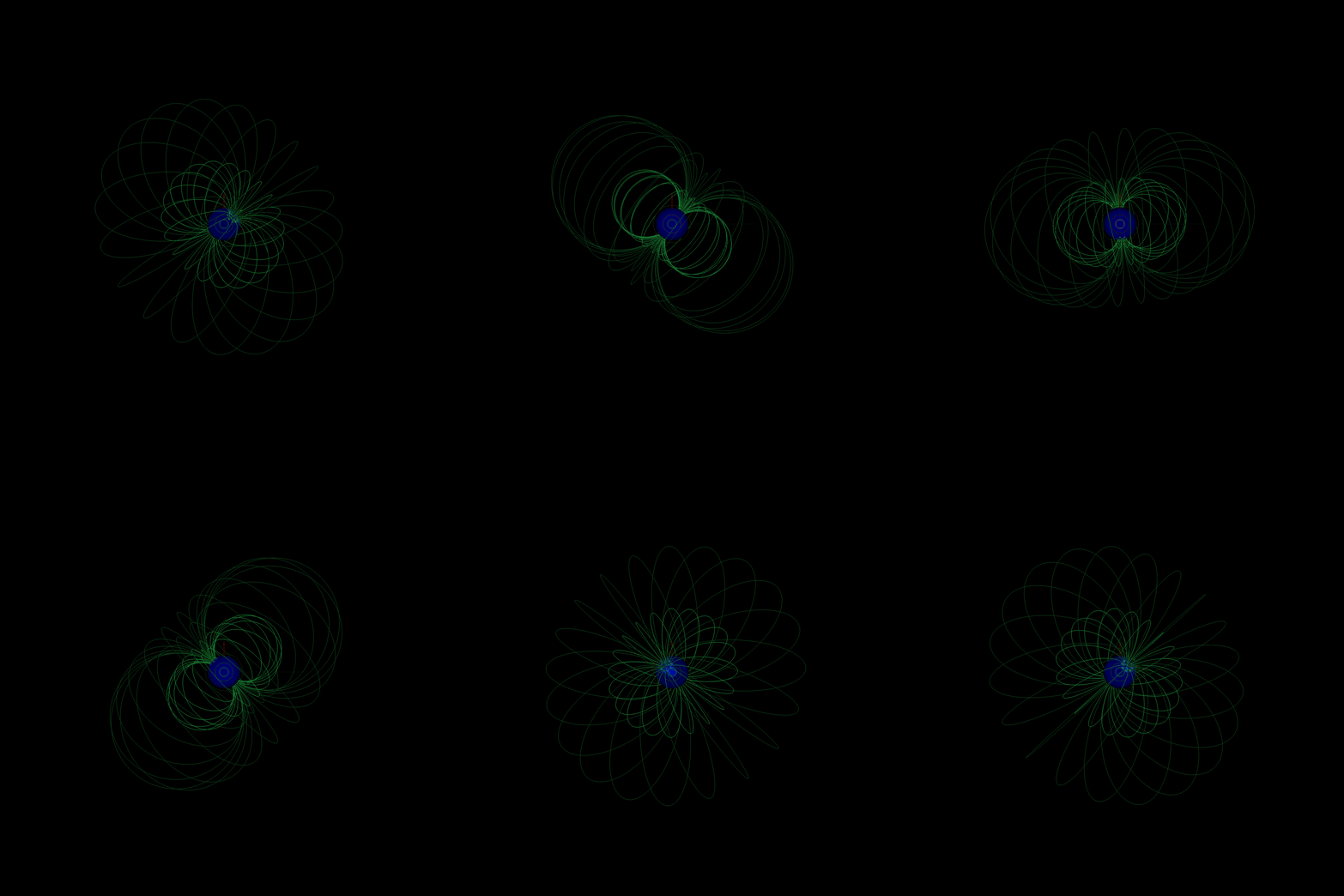
Welcome to Pulsar Digital Twin PulsarDT++! python package Version. This package in its current form provides a digital twin/animation of a Pulsar. Using this package a user can design a pulsar source with a customized radio emission pattern or sparks. In addition specific physics such as spectral emission profile associated with each sparks can also be modelled. The sparks can also have their own drift velocity. At its present form a method is provided to make sparks arranged in nested cone pattern. A pipeline is also provided to generate random frequency-time graphs containing Pulsar+NBRFI+BBRFI dataframes which will be used to train neural network models to detect pulsars from radio data streams generated from radio-telescopes like MeerKAT.
Installation
You can install PulsarDT from the Git repository as:
git clone https://gitlab.dzastro.de/punch/ml-ppa/pulsardtpp.git
cd pulsardtpp
python -m venv .venv
source .venv/bin/activate
pip install uv
uv pip install .
Example Hello World
Here is how to use PulsarDT in a simple script:
import numpy as np
import pulsardtpp.defines as defines
from pulsardtpp import PulsarAnimator
from pulsardtpp import create_pulsar_animation

pulsar_animator = PulsarAnimator(rot_axis=[0,0,1],mag_axis_tilt=45)
create_pulsar_animation(
                     pulsar_animator=pulsar_animator,
                     animation_folder_path='./output/anims/',
                     tag='test_spark',
                     telescope_direction=(1,0,1),
                     rot_phases=np.arange(0, 360, 30),
                     res=60
                     )
The following GIF shows an example animation created by stacking the frames generated by the above code: